
For most Indian manufacturers, business has traditionally come from three places: a stall at a trade exhibition, a network of distributors, and referrals. None of that has stopped working. It just isn’t enough on its own anymore.
Here’s what changed quietly over the last few years. A purchase manager at a mid-sized company, or an importer sitting in Dubai or Hamburg, no longer waits for your sales rep to call. By the time they speak to a human, they’ve already searched, compared three or four suppliers, opened a few spec sheets, and drawn up a shortlist. If your company doesn’t appear during that research, you don’t lose the deal at the negotiation table. You lose it before you even know it existed.
That is the gap search closes. Done properly, SEO for manufacturers in India is less about “ranking for keywords” and more about being visible at the exact moment a serious buyer is trying to find what you make — and giving that buyer enough to trust you before the first email. This guide is written for factory owners, promoters and marketing heads who want organic search to produce enquiries, not just a nicer-looking website.
What SEO actually means for a manufacturing business
Strip away the jargon and manufacturing SEO comes down to one outcome: the right buyer finds your product page, believes you can supply, and sends an enquiry.
That “right buyer” is rarely a consumer. It’s a procurement executive, a project engineer, a channel partner looking for a new principal, or an overseas importer. They aren’t buying on impulse and they aren’t buying one unit. So the goal isn’t traffic volume. A textile machinery manufacturer getting forty relevant visits a month from people searching “twisting machine for polyester yarn manufacturer” is in a far stronger position than one getting four thousand visits from students writing project reports.
Everything below is built around that idea. Fewer, better-qualified visitors who turn into RFQs, distributor enquiries and export leads.
Why manufacturing SEO is a different game
If you’ve read generic SEO advice and found it unhelpful, that’s because most of it is written for e-commerce stores and local service businesses. B2B manufacturing has its own rules.
The search volumes are small but the intent is deep. “Industrial water chiller manufacturer in India” may get only a few hundred searches a month, but almost everyone typing it is a genuine buyer. Consumer keywords are the opposite — huge volume, shallow intent.
The sales cycle is long and multi-touch. Someone may find you in January, download a datasheet, disappear, and enquire in April after budget approval. Your website has to do quiet convincing across that whole gap.
The buyer is technical. They want dimensions, material grades, capacities, tolerances, certifications and application fit — not marketing adjectives. A page that says “we are a leading manufacturer of quality products” tells them nothing.
And then there’s the India-specific reality that most articles skip: over-dependence on marketplaces. A large share of Indian manufacturers treat IndiaMART, TradeIndia or Justdial as their entire online presence and let their own website sit as a static brochure. Marketplaces have their place for volume enquiries, but you’re renting attention there, competing on price beside twenty others, and building someone else’s asset. Your own site ranking in Google is the one channel you actually own. Treating it seriously is what separates manufacturers who generate steady organic leads from those who keep paying for every enquiry.
How industrial buyers really search
Understanding the search journey matters more than any keyword list, because it tells you what pages you actually need. A typical B2B buyer moves through roughly four stages:
Problem stage — they describe a problem, not a product. “How to reduce rejection in injection moulding” or “coating not adhering to galvanised sheet.” They don’t know you yet, and this is where useful content earns early trust.
Product / solution stage — now they know what they need. “Servo-driven pouch packing machine,” “IE3 three-phase induction motor,” “CNC turned automotive components.”
Specification stage — the technical filter. “PP woven fabric GSM chart,” “flameproof motor IP rating,” “food-grade lubricant NSF certified.” This is where thin websites get eliminated.
Supplier stage — they add qualifiers: “…manufacturer in India,” “…supplier in Ahmedabad,” “…exporter.” These are the highest-intent searches you can rank for.
Most manufacturers only build pages for the last stage and wonder why the pipeline is thin. The buyers who convert best have often been reading your specification and application content for weeks before they ever search your category plus “manufacturer.”
The keywords worth targeting (with real examples)
Commercial keywords for manufacturers usually fall into a few clean buckets. Rather than a giant list, think in patterns and apply them to your own products:
- Product + “manufacturer / supplier / exporter” — the core commercial terms. Industrial machinery: “rice mill machinery manufacturer India.” Chemicals: “sodium lauryl sulphate supplier India.”
- Product + application — how buyers frame a specific use. Packaging equipment: “vacuum packing machine for spices.” Electrical components: “terminal blocks for control panels.”
- Product + specification — the technical long-tail. Automotive parts: “forged steel connecting rod for tractor engine.” Textiles: “150 GSM cotton canvas roll.”
- Product + location — for buyers who prefer regional supply. “Sheet metal fabrication in Pune,” “pharma machinery manufacturer in Vadodara.”
- Comparison and buying-intent — “best material for food packaging film,” “how to choose a hydraulic press tonnage.”
An engineering-products firm might have fifty such phrases across its range. You don’t chase all of them at once. You map each to a page, prioritise the ones closest to a purchase, and build outward.
Fix the site structure before anything else
This is where the real leverage is, and where most manufacturing websites are broken. The common problem: everything is crammed onto one “Products” page or a PDF catalogue, so there’s no individual page for Google to rank against a specific search. If a buyer searches “twin screw extruder manufacturer” and your extruder lives three clicks deep inside a downloadable brochure, you simply won’t appear.
A structure that works looks like this:
- Category pages for each product family (e.g. Packaging Machinery), explaining the range and who it’s for.
- Individual product pages for each machine or SKU family — the workhorses of manufacturing SEO. Each carries its own specifications, applications, materials, capacities and enquiry option.
- Application or industry pages that map products to sectors — “packaging solutions for the pharma industry,” “components for the automotive aftermarket.” Buyers often search by their own industry, not your product name.
A useful test: pick your five best-selling products and ask whether each has a dedicated, indexable page with real specifications. If the answer is no, that’s your first month of work, ahead of anything else.
Product pages that get shortlisted
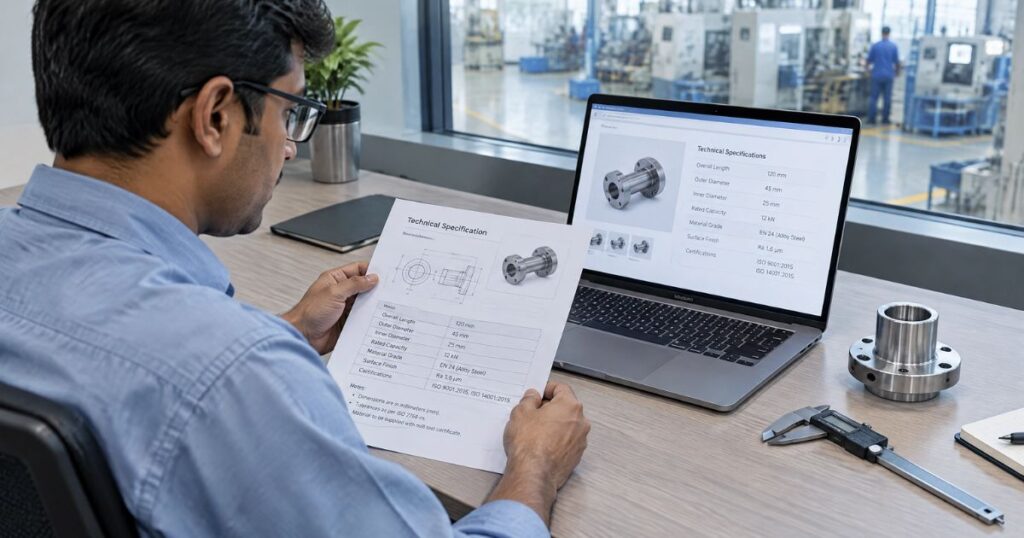
A product page that earns enquiries reads like a spec sheet written for a human, not a poster. At minimum it should carry the technical specifications a buyer needs to shortlist you (dimensions, capacity, power, material grade, output), the applications and industries it suits, relevant certifications or standards (ISO, CE, BIS, GMP, RoHS as applicable), and a genuinely visible way to enquire.
Two things quietly matter here. First, put the specs as text on the page, not only inside an image or a PDF — search engines read text far more reliably. A downloadable datasheet is good; a text spec table plus the datasheet is better. Second, use Product and Organization structured data so search engines understand what the page is; Google’s documentation supports this markup and it helps your listing make sense in results.
Technical SEO for manufacturing websites
Manufacturing sites tend to have a specific set of technical problems, and fixing them often unlocks rankings that better content alone can’t. The usual suspects: heavy, unoptimised product images that slow pages to a crawl; important content locked inside PDFs or JavaScript that isn’t easily crawled; no logical internal linking between related products; and duplicate or near-empty pages generated by the CMS. Add poor mobile rendering, which matters because a surprising number of B2B buyers do their first search on a phone.
You don’t need to become a developer, but you should make sure the basics are handled: fast-loading pages, a clean crawlable structure, correct indexing of the pages you care about (and no-indexing of the ones you don’t), an XML sitemap, and a mobile layout that actually works. If you want the full checklist, this deserves its own read — see Media Sathi’s technical SEO guide.
Content that earns industrial enquiries
This is where manufacturers can genuinely out-rank larger competitors, because so few of them do it well. The content that works for B2B isn’t blog fluff. It’s the material your best sales engineer already explains on calls, written down. Practical examples that consistently attract serious buyers:
- Application notes — “choosing the right conveyor belt for high-temperature environments.”
- Buying and selection guides — “how to select pump capacity for your flow rate,” which attracts decision-stage buyers.
- Comparison content — “SS 304 vs SS 316 for food processing equipment.”
- Problem-solving content — the questions buyers actually type when something isn’t working.
Aim to demonstrate real, first-hand engineering knowledge. Google’s people-first content guidance rewards material that shows genuine experience and expertise, and industrial buyers reward the same thing with trust. A chemicals manufacturer publishing a clear, accurate note on safe handling and storage of a specific solvent builds more credibility than ten generic “why choose us” pages. If content is a channel you want to build systematically, that’s exactly where a content marketing approach tuned for B2B earns its keep.
Local visibility and Google Business Profile — the honest version
A lot of “SEO for manufacturers” advice tells everyone to optimise a Google Business Profile. The reality is more nuanced, and it’s worth being accurate.
Google Business Profile is designed for businesses that make in-person contact with customers. According to Google Business Profile’s own eligibility rules, a business qualifies when it either serves customers at its location or travels to meet them. A factory that regularly receives buyers, distributors or clients at its office or works — and many do — can legitimately maintain a profile, and it genuinely helps for searches like “PVC pipe manufacturer in Kanpur” and for the map pack. A pure manufacturing unit with no in-person dealings has a weaker case, and forcing a listing that doesn’t fit can cause more trouble than it solves.
So the practical approach is: if you have a real premises where you meet buyers, set up and optimise the profile properly — accurate name, address and category, product photos, and regular updates. If your leads are national or export-driven rather than “near me,” put your energy into national keyword rankings instead. For the businesses where local search does matter, Media Sathi’s guide to building a local SEO strategy walks through it in detail.
Export SEO: getting found by overseas buyers

For manufacturers with export ambitions — and much of Indian manufacturing has them — this is where owned search becomes especially valuable, because international buyers begin almost every sourcing decision with a search or a query to an AI assistant.
A few principles that matter here. Target the buyer’s language and framing, not just yours; an importer may search “industrial valve supplier India” or a country-specific term. If you serve distinct regions with distinct pages, use correct country or language signals so the right version shows to the right buyer. And invest heavily in trust signals, because a foreign buyer taking a risk on an unknown Indian supplier is scanning for reassurance: certifications, export documentation capability, factory photos and videos, capacity details, client industries served, and clear contact routes including WhatsApp.
The strategic point: marketplaces will send you price-shopping enquiries from anywhere. Your own website ranking for “[your product] manufacturer India” tends to attract buyers who’ve already decided they want a direct, longer-term supplier relationship. Those are better leads.
Getting cited in AI answers
Buyers increasingly ask an AI assistant or read Google’s AI-generated summaries before they click anything. You can’t control this directly, but the same fundamentals help: clear, factual, well-structured pages with genuine specifications and straightforward answers to real buyer questions are easier for these systems to understand and surface than vague marketing copy. Writing precisely — stating exactly what you make, for whom, with what specifications — is increasingly both good SEO and good “AI visibility.” No one can promise citation, but thin brochure sites are the least likely to earn it.
Building authority without spammy backlinks
Authority still matters, but the shortcut era is over, and buying links or spamming directories is a fast way to damage a serious brand. What actually builds trust for a manufacturer: listings in genuinely relevant industry directories and association pages (your sector body, export promotion councils, verified trade platforms); coverage or mentions earned through real activity — a new plant, a certification, participation in an industry event; and content good enough that suppliers, partners or trade publications reference it on their own. Case studies, technical resources and clear company information (leadership, history, certifications, facilities) all strengthen the trust signals Google’s guidance associates with expertise and authoritativeness. Earned, slow and real beats bought, fast and risky every time.
Turning organic traffic into enquiries
Traffic that doesn’t convert is a vanity number. B2B conversion optimisation is its own discipline, and small changes often matter more than more visitors. Make enquiry effortless and offer more than one route — a short RFQ form, a visible phone number, and WhatsApp, which many Indian B2B buyers strongly prefer. Let buyers self-qualify by downloading a spec sheet or catalogue in exchange for a contact detail. Put trust signals where the decision happens: certifications, client logos or industries served, and real factory imagery near the enquiry button. And keep forms short — a procurement manager will abandon a fifteen-field form. Name, company, requirement and contact are usually enough to start a conversation.
Measuring what actually matters
Ignore the dashboards that only flatter. For a manufacturer, the metrics worth tracking are the ones tied to revenue: enquiries and RFQs from organic search sit at the top — the actual business outcome. Below that, keyword coverage for your priority commercial and product terms, impressions and clicks for those queries in Google Search Console, and the growth of indexed, ranking product and application pages over time. Rankings and traffic are useful leading indicators, but only when they feed the enquiry number. Review quarterly, not daily; SEO moves in months, and reading it week to week only produces anxiety.
Common mistakes to avoid
- Treating the website as a digital brochure instead of a lead engine, and outsourcing all lead-gen to marketplaces.
- Hiding products inside PDFs and image catalogues with no individual, indexable pages.
- Writing marketing adjectives instead of specifications the buyer needs.
- Chasing high-volume generic keywords over low-volume, high-intent commercial ones.
- Ignoring mobile, speed and basic technical hygiene.
- Buying cheap backlinks and hoping for shortcuts.
- Expecting results in three weeks. Meaningful organic movement in a competitive B2B niche typically takes months, and anyone promising instant rankings is best avoided.
A practical 90-day SEO roadmap
This is a realistic sequence for an Indian manufacturing company starting more or less from scratch. It won’t finish the job — SEO is ongoing — but it builds the right foundation and usually produces early enquiries.
Days 1–30 — Foundation and priority pages
Audit the current site and identify what’s indexed and what isn’t. Do keyword research around your actual product range, grouped by the buyer stages above. Pick your top five to ten commercial and product terms. Build or rewrite dedicated pages for your five best-selling products with full text specifications and clear enquiry options. Fix the worst technical issues — page speed, mobile, broken indexing. If you genuinely meet buyers at your premises, set up or clean up your Google Business Profile.
Days 31–60 — Structure and content
Build out category and application/industry pages so your range is properly organised and internally linked. Publish three to four genuinely useful pieces — a selection guide, an application note, a comparison — targeting decision-stage searches. Add Product and Organization structured data. Strengthen trust elements: certifications, about/facility pages, real photos. Register on relevant, credible industry directories and your association pages.
Days 61–90 — Authority, conversion and iteration
Improve conversion paths: simplify forms, add WhatsApp, place trust signals near enquiry points. Pursue two or three earned mentions or quality directory listings. Review Search Console for terms you’re beginning to rank for and expand the pages that are gaining traction. Set up simple tracking so every enquiry’s source is known. Then plan the next quarter — because the compounding starts after this, not during it.
When it makes sense to hire an agency
Plenty of the above can be started in-house, especially the parts only your engineers can write. Bringing in a partner tends to make sense when the technical fixes need real development work, when you’re targeting export markets and need country-level strategy, when you have a large product range that needs proper architecture, or simply when no one internally has the time to run it consistently for the six-plus months it takes to pay off. The honest test is capacity and expertise, not company size.
Conclusion
SEO isn’t a replacement for your exhibitions, distributors and referrals. It’s the channel that feeds all of them — the always-on presence that puts your products in front of buyers who are already looking, months before your competitors’ sales teams get a chance to call. For Indian manufacturers, the opportunity is unusually open, because so many firms still treat their website as an afterthought. The ones that build proper product pages, publish real technical knowledge, and make enquiry easy are quietly compounding an asset their competitors don’t have.
None of this promises rankings or leads on a timeline — anyone who does is selling you something. What it does promise is a durable, owned channel that gets stronger the longer you invest in it.
Work with Media Sathi
Every manufacturing business has a different product range, buyer profile, geography and set of lead-generation goals, and a good SEO plan starts from those specifics rather than a template. If you’d like a customised strategy built around your products, your target markets and where your buyers actually are, Media Sathi can put one together for you — request a free growth audit and we’ll show you where the opportunities sit. You can also explore our full SEO services to see how we approach B2B search.
FAQs :
Q1. How long does SEO take to generate leads for a manufacturing company?
In a competitive B2B niche, meaningful organic movement usually takes several months — often three to six before steady enquiries appear, and longer for very competitive product categories or export terms. Product pages targeting specific, lower-competition technical searches can start pulling qualified visitors sooner. It’s a compounding channel, not an instant one.
Q2. Is SEO better than IndiaMART or TradeIndia for getting enquiries?
They serve different purposes. Marketplaces can bring quick volume but you compete on price beside many others and build no owned asset. Your own site ranking in Google attracts buyers looking for a direct, longer-term supplier and gives you full control of the relationship. Most manufacturers benefit from using both while steadily reducing dependence on marketplaces.
Q3. Do manufacturers really need a Google Business Profile?
Only if you genuinely serve or meet buyers, distributors or clients at your location — Google’s eligibility rules are built around in-person contact. If you do, it helps for local and regional searches. If your leads are national or export-driven, national keyword rankings usually matter more than a local listing.
Q4. What kind of content should a manufacturer publish?
The knowledge your sales engineers already share on calls: selection guides, application notes, specification explainers and comparisons. Content that demonstrates real technical expertise builds trust with buyers and aligns with what search engines reward. Generic “why choose us” blogs add little.
Q5. How is SEO for B2B manufacturers different from normal SEO?
Search volumes are smaller but intent is far deeper, sales cycles are long and multi-touch, and buyers are technical and want specifications rather than marketing language. The strategy centres on a small number of high-intent commercial keywords and strong product and application pages, not high traffic.
Q6. Can SEO help us reach export buyers?
Yes. International buyers begin sourcing with a search or an AI query, and a website ranking for your product plus “manufacturer India” tends to attract buyers who want a direct supplier. Strong trust signals — certifications, export capability, factory imagery and easy contact — matter as much as rankings for overseas leads.
Q7. We already have a website. Why aren’t we getting enquiries from it?
Usually because products sit inside PDFs or one crowded page with no individual indexable pages, the content is marketing copy rather than specifications, or basic technical issues stop the site ranking. A structural audit typically reveals the bottleneck quickly.


