
When someone in India needs a doctor, the search usually starts on a phone. “Dermatologist in Noida,” “dentist near me,” “gynaecologist in Delhi” — a patient types a few words, glances at the map results, reads a couple of reviews, checks the timings, and decides who to call. Very often they already have a name from a friend or a referral, and they’re simply verifying: is the clinic real, where is it, when is it open, does it look trustworthy? Either way, if your practice is hard to find, or the information shown is wrong or missing, you’ve lost that person’s confidence before they ever reach your door.
Local SEO for doctors in India is the work of making sure patients can find accurate, trustworthy information about you and your clinic at that moment — your name, specialty, services, location, hours and how to get in touch. Handled responsibly, it isn’t advertising and it isn’t about chasing patients. In fact, it can’t be: doctors in India work under professional-conduct rules that restrict soliciting patients and self-promotion. Good local SEO for a clinic is really about accurate discoverability and trust — and framed that way, it’s both effective and ethical. This guide is written for doctors, clinic owners and practice managers who want to be found for the right reasons.
What local SEO actually means for a doctor or clinic
Set aside the jargon. Local SEO simply means that when a patient nearby searches for the kind of care you provide, your practice appears with correct, complete and reassuring information. That’s the name of the doctor and clinic, the specialty, the services offered, the address and directions, the opening or OPD hours, the contact number, and how to book or walk in. For a patient, this is a trust exercise as much as a search one — they are deciding whether to hand their health, or their child’s, to someone they found online.
So the goal isn’t traffic for its own sake, and it certainly isn’t persuasion. It’s discoverability: being present and accurate at the moment of need, so that a patient who would benefit from your care can actually find and reach you.
How patients search, and how local results work
Two search patterns dominate healthcare. The first is specialty plus place — “paediatrician in Kanpur,” “skin clinic in Gurgaon,” “orthopaedic doctor near me.” The second is verification — a patient with a name in hand searching for the clinic to check its location, timings and reviews. Both usually surface Google’s local results: the small map with a short list of nearby practices, drawn largely from Google Business Profiles, sitting above the ordinary web links.
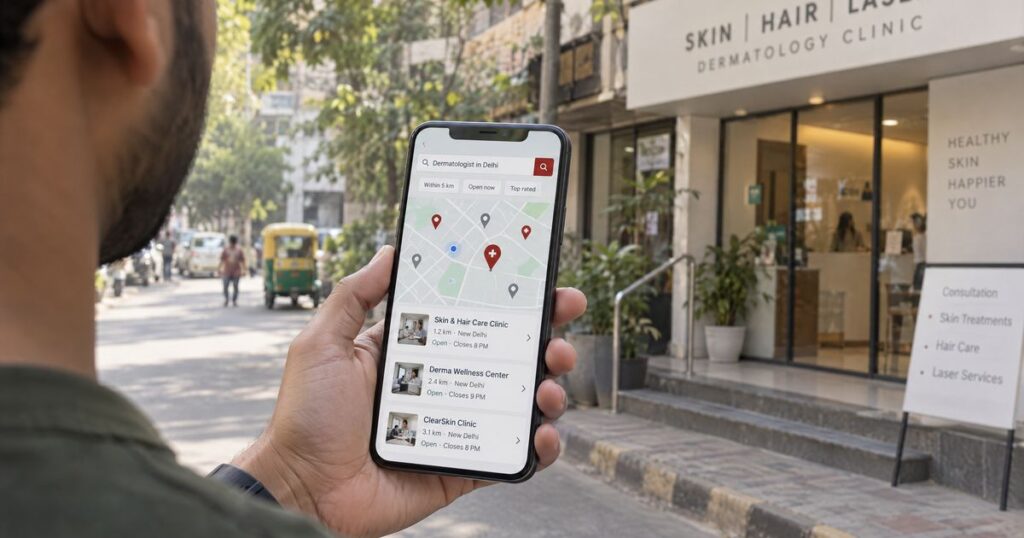
It’s worth being realistic about the rest of that page. Alongside the map, healthcare directories and appointment platforms — the well-known aggregators — and larger hospital websites often occupy the standard results. You’re not going to displace all of them, and you don’t need to. The practical strategy runs on two tracks: get your Google Business Profile and your own website right so you appear strongly in the local map and for your own name and services, and make sure your listings on the major directories are accurate and consistent so the information patients see about you is correct wherever they look.
Google Business Profile: the centre of local SEO for clinics
For most practices, the single highest-value piece of local SEO is a well-run Google Business Profile. It’s usually the first thing a patient sees, and it directly feeds the map results. There’s an important healthcare-specific nuance here that trips people up: Google distinguishes between a practice and an individual practitioner, and it allows both.
According to Google’s own guidelines, a clinic or hospital has a Business Profile for the location, and an individual public-facing doctor may have their own separate profile as a practitioner. A few rules follow from that, and they matter:
- One profile per practitioner — not one per specialty. A doctor shouldn’t create multiple profiles to cover different treatments they offer.
- Names stay clean. A practitioner profile may include a title or degree (for example “Dr.” or “MD”), but not stuffed keywords or promotional words. “Dr. A. Sharma” is fine; “Best Skin Doctor Noida Dr. A. Sharma” is a policy violation that risks suspension.
- Solo doctor in a branded clinic. Google’s suggested format is to combine them as “Clinic Name: Dr. Practitioner Name” on a single profile, rather than creating duplicates.
- Multi-doctor clinic. The organisation keeps the location profile; each public-facing doctor’s own profile uses just their name. Support staff don’t get profiles.
Beyond that structure, complete the profile properly: choose the most accurate primary category (for example, “Dermatologist” or “Dental clinic”) plus relevant secondary categories, list precise address and service area, set correct hours including OPD timings, add the appointment or booking link if you use one, and upload genuine photos of the actual clinic. Keep the name, address and phone number identical to what’s on your website and everywhere else online — inconsistency quietly weakens both trust and local ranking. And keep an eye on the questions-and-answers section, because patients ask there and Google shows the answers publicly.
Practitioner information and credentials
Patients and search engines both reward clear, accurate professional information, and health is exactly the kind of topic where that credibility carries the most weight. Give each doctor a real profile: qualifications, registration and specialties, areas of focus, languages spoken, and the clinics they practise at. State these accurately and keep them current. Never invent or embellish credentials or experience — apart from the obvious ethical and legal problems, patients and referrers do check, and a single inflated claim can undo years of trust. Accurate, verifiable practitioner information is one of the strongest, and most honest, signals you can give.
Your website: location, service and specialty pages
Your Business Profile brings visibility; your website is where a cautious patient goes to be reassured. Give it a clear structure: a page for each real clinic location with address, map, directions, parking and public-transport notes and hours; service or treatment pages that explain, in plain and responsible language, what you offer and what a patient can expect; specialty pages where relevant; and the practical, administrative information patients actually look for — how to book an appointment, what to bring, payment or insurance details, and answers to common front-desk questions.
One firm caution: build a location page only for a clinic you genuinely operate. Spinning up near-identical “[specialty] in [area]” pages for neighbourhoods you don’t have a presence in is doorway-page behaviour, it helps no patient, and Google’s guidelines specifically discourage it. If your current site can’t support clean, fast location and service pages, that’s a website development fix worth making before anything else.
Reviews and reputation — handled ethically
Reviews influence healthcare choices heavily, because the stakes are personal. A steady flow of genuine, recent reviews is one of the most persuasive things a practice can have. Earn them the honest way: make it easy for patients to leave feedback — a direct review link at the reception desk or in a follow-up message — and simply ask satisfied patients to share their experience. Do not buy reviews, post fake ones, or offer incentives that breach platform policies; beyond the policy risk, patients recognise a manufactured wall of five stars, and it erodes the trust you were trying to build.
Responding to reviews is good practice, but healthcare adds a duty most businesses don’t face: privacy. A public reply that confirms someone was your patient, or references their visit or condition, can breach their confidentiality even when you mean well. Keep replies courteous and general — thank the person, acknowledge the feedback, and move any specifics to a private channel. For a negative review, respond calmly and professionally; prospective patients read your composure as closely as the complaint.
Content that genuinely helps patients
The most useful content for a clinic is rarely medical advice — it’s the practical, administrative information patients hunt for and rarely find: how to prepare for a particular appointment or test, what documents or previous reports to bring, how to reach the clinic and where to park, consultation and payment details, and clear answers to the questions your front desk fields all day. This kind of content is genuinely helpful, entirely within the rules, and it quietly supports your visibility. A steady, patient-first content marketing habit compounds over time.
If you do publish health-information content — explaining a condition or procedure at a general level — write it responsibly, keep it factual, avoid anything that reads as diagnosis or treatment instruction, and have it reviewed by a qualified professional. Only state that a page has been medically reviewed if a suitably qualified person has genuinely reviewed it; a false “medically reviewed by” line is both dishonest and, on a health topic, exactly the kind of trust signal that backfires. Never write medical content purely to chase traffic.
Technical SEO, mobile and structured data
Most patients reach you on a phone, often in a hurry or in discomfort, so a fast, mobile-friendly site with an obvious call button isn’t optional. Cover the fundamentals: quick-loading pages, secure HTTPS, a clean and crawlable structure, correct indexing, and an XML sitemap. Structured data — marking up your clinic and doctors with the appropriate medical-organisation, physician or local-business schema — helps search engines understand exactly who and what you are; treat it as clarity, not a trick, and keep it strictly accurate. The deeper checklist lives in Media Sathi’s technical SEO guide.
Local citations, mentions and honest authority
Consistency and legitimacy build local trust. Make sure your practice is listed accurately — same name, address and phone — across the directories and health platforms patients use, and correct any old or wrong entries. Genuine local relevance also helps: a health talk you gave, a camp your clinic ran, a mention in local media, an association or hospital affiliation. What you should avoid is the shortcut of buying links or planting spammy citations; on a health topic especially, low-quality link schemes carry more risk than reward. Real affiliations and real community presence are both the safer and the more credible path.
A note on the rules doctors work under
Unlike most local businesses, medical practitioners in India operate inside a professional-conduct framework, and it shapes what your online presence should and shouldn’t say. The Indian Medical Council (Professional Conduct, Etiquette and Ethics) Regulations, 2002 — currently the operative code, after the National Medical Commission’s 2023 conduct regulations were placed in abeyance — treat soliciting patients, directly or indirectly, and self-promotional claims about a doctor’s skill or achievements as unethical. Separately, the Drugs and Magic Remedies (Objectionable Advertisements) Act, 1954 prohibits advertisements claiming to cure or guarantee results for certain conditions.
This isn’t legal advice, and the position evolves — confirm the current rules, and take professional guidance where a real campaign is involved. But the practical takeaway is simple and it runs through everything above: keep your online information factual. State what you treat, your qualifications, your services, your timings and how to reach you. Steer clear of “best dermatologist in the city,” guaranteed outcomes, and cure claims. Factual discoverability isn’t just the compliant path — for a wary patient, it’s also the more trustworthy one.
Turning discovery into booked appointments
Being found only matters if the patient can easily take the next step. Make contact effortless and offer more than one route: a prominent click-to-call number, a WhatsApp option many patients prefer, an appointment link if you use online booking, and clear directions. Keep any enquiry form short — name, contact, and the reason for the visit at a general level are enough to begin. Place quiet reassurances near the point of action: accurate hours, the doctor’s genuine qualifications, real photos of the clinic. Small frictions — a wrong number, a broken form, unclear timings — cost real patients, so test these regularly from a patient’s point of view.
Tracking calls, forms and appointments
You can’t improve what you don’t measure, so make sure every contact’s source is visible. Track which calls and form submissions come from organic search and from your Google Business Profile, watch profile calls and direction requests, and in Google Analytics and Search Console look past totals to which pages and queries actually produce contacts. Read it with the calendar and context in mind, and review over months rather than days — local visibility builds gradually. The point isn’t a prettier dashboard; it’s knowing which parts of your presence bring patients so you can strengthen them.
What not to do
Some tactics circulate in local SEO that are risky anywhere and especially unwise in healthcare. Avoid all of the following — each carries real consequences:
- Fake or incentivised reviews. Against platform policy, easy for patients to spot, and corrosive to trust.
- Fake addresses or virtual-office manipulation. Google verifies real locations; a mailbox or an office you don’t operate from gets a profile suspended.
- Keyword-stuffed business or practitioner names. “Best Skin Clinic Near Me” as a name breaches Google’s rules and invites suspension.
- Duplicate location pages or doorway pages for areas you don’t serve — no patient benefit, and against Google’s guidelines.
- Fake practitioner profiles or profiles for support staff who aren’t public-facing providers.
- Misleading medical claims — cure guarantees, “100% success,” self-laudatory superlatives — which can breach both Google’s policies and India’s medical-advertising rules.
- Spammy backlinks bought in bulk, which risk penalties for little lasting gain.
- Mass-produced, thin content churned out for keywords — the scaled-content pattern Google works to demote, and a poor fit for a trust-critical field.
Common mistakes clinics make
- Leaving the Google Business Profile unclaimed, incomplete, or with outdated hours.
- Inconsistent name, address and phone across the website, Google and directories.
- A slow, non-mobile site that hides the call button.
- Ignoring reviews, or replying in ways that reveal patient details.
- Confusing the practice listing with individual practitioner listings, or creating duplicates.
- Over-claiming in copy — superlatives and guarantees that undermine trust and cross compliance lines.
- Expecting instant results. Local visibility builds over months, and no honest partner will promise rankings or patient numbers.
A practical 90-day roadmap
A realistic starting sequence for a clinic new to local SEO.
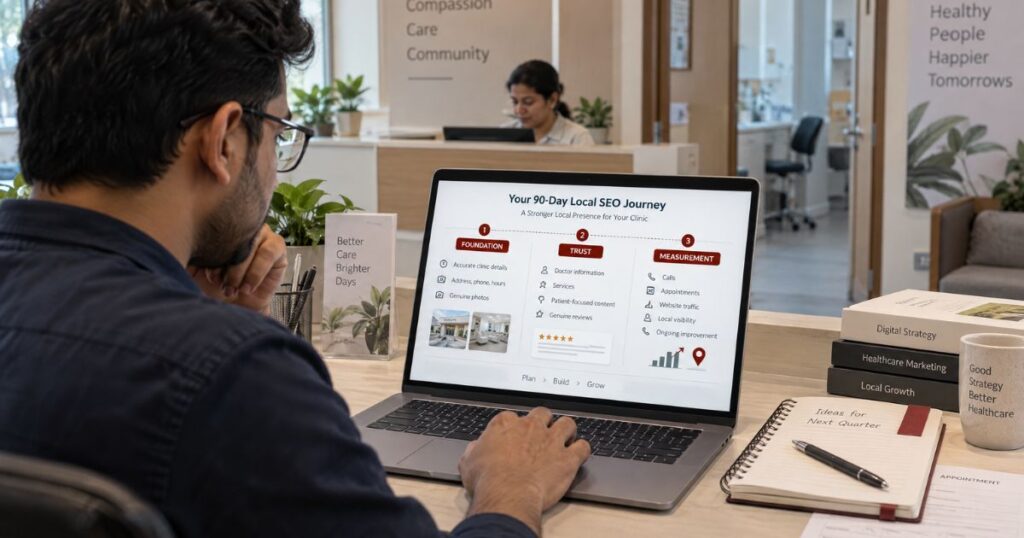
Days 1–30 — Foundation
Claim and verify your Google Business Profile (and set up practitioner profiles correctly where relevant). Get the essentials right: accurate category, address, hours, phone and photos, consistent with your website. Audit your name-address-phone across major directories and fix errors. Make sure your website has a correct location page, working contact options and a clear call button, and fix the worst technical and mobile issues.
Days 31–60 — Information and trust
Build or improve genuine doctor profiles with accurate credentials, and clear service and appointment-information pages. Add the practical, patient-focused content people actually search for. Start earning genuine reviews and set a simple, respectful process for responding to them. Add accurate structured data. Correct any remaining directory inconsistencies.
Days 61–90 — Refinement and measurement
Tighten conversion paths — call, WhatsApp, booking, directions — and test them as a patient would. Pursue one or two genuine local mentions or affiliations. Set up tracking so you know which pages and listings bring contacts, review what’s working in Search Console and your Business Profile insights, and plan the next quarter. Keep everything factual and compliant throughout.
When to bring in help
Much of this a capable practice manager can start in-house. Outside help tends to make sense when the website needs real development work, when you run several locations or many practitioners that each need correct local setup, when directory and profile issues have become tangled, or when no one internally has time to maintain it consistently. The right test is capacity and expertise — and, in healthcare, a partner who understands the compliance and trust considerations, not just rankings.
Conclusion
For a doctor or clinic, local SEO isn’t about marketing louder than the practice down the road. It’s about making sure that a patient who needs your care can find you, see accurate information, and reach you with confidence — all within the professional and ethical boundaries medicine in India requires. Get the Google Business Profile right, keep your information accurate and consistent, earn genuine reviews, help patients with honest practical content, and make contact easy. None of this guarantees rankings or patient numbers, and anyone promising that should be treated with caution. What it does build is a trustworthy, findable presence — which, for a healthcare practice, is exactly the point.
A note from Media Sathi
Every practice is different — a solo clinic, a multi-doctor centre and a hospital each need a different local-search setup, and healthcare adds trust and compliance considerations most sectors don’t. If you’d like help improving your visibility responsibly — Google Business Profile, local SEO, an accurate website and genuine reputation-building — Media Sathi works with healthcare businesses and can put together a plan suited to your practice. You can see our approach on the Health & Wellness page, explore our SEO services, or book a free growth audit to talk it through. No commitment required.
FAQs :
Q1. Is local SEO even allowed for doctors in India, given the advertising rules?
Yes, when it’s approached as accurate discoverability rather than solicitation. The IMC 2002 ethics regulations restrict soliciting patients and self-promotional claims, so the compliant approach is factual: your name, specialty, qualifications, services, location, hours and contact details — not superlatives, guarantees or cure claims. Where a marketing campaign is involved, take professional guidance.
Q2. Should an individual doctor have a separate Google Business Profile from the clinic?
Often, yes. Google treats a public-facing doctor as an individual practitioner who can have their own profile, separate from the clinic’s location listing. Keep it to one profile per doctor (not one per specialty), use only the doctor’s name and title/degree without keyword stuffing, and avoid duplicates.
Q3. How do we get more Google reviews without breaking the rules?
Make it easy — a direct review link at reception or in a follow-up message — and simply ask satisfied patients. Don’t buy, fake or incentivise reviews. When you reply, stay courteous and general and never reveal that someone was a patient or mention their condition, as that can breach their privacy.
Q4. Can we write blog articles about medical conditions to get traffic?
You can publish general, responsible health information, but write it carefully, avoid anything resembling diagnosis or treatment advice, and have it reviewed by a qualified professional — and only label it “medically reviewed” if that genuinely happened. More useful, and lower-risk, is practical patient content: appointment preparation, what to bring, access and payment details.
Q5. How long does local SEO take to make a difference for a clinic?
Usually a few months of consistent work before visibility builds meaningfully, and it depends on your city and specialty. It’s a gradual, compounding process, not an overnight switch — and no one can honestly guarantee a ranking or a number of patients.
Q6. Do we need a website if we already have a Google Business Profile and a Practo-style listing?
A profile and directory listings help you be found, but your own website is where a cautious patient goes to verify you and understand your services — and it’s the one presence you fully control. The strongest setup uses all three, with consistent, accurate information across them.
Q7. What’s the single most important thing to get right first?
A complete, accurate, verified Google Business Profile with correct category, address, hours, phone and genuine photos — consistent with your website. For most clinics it’s both the first thing patients see and the biggest early win.


