
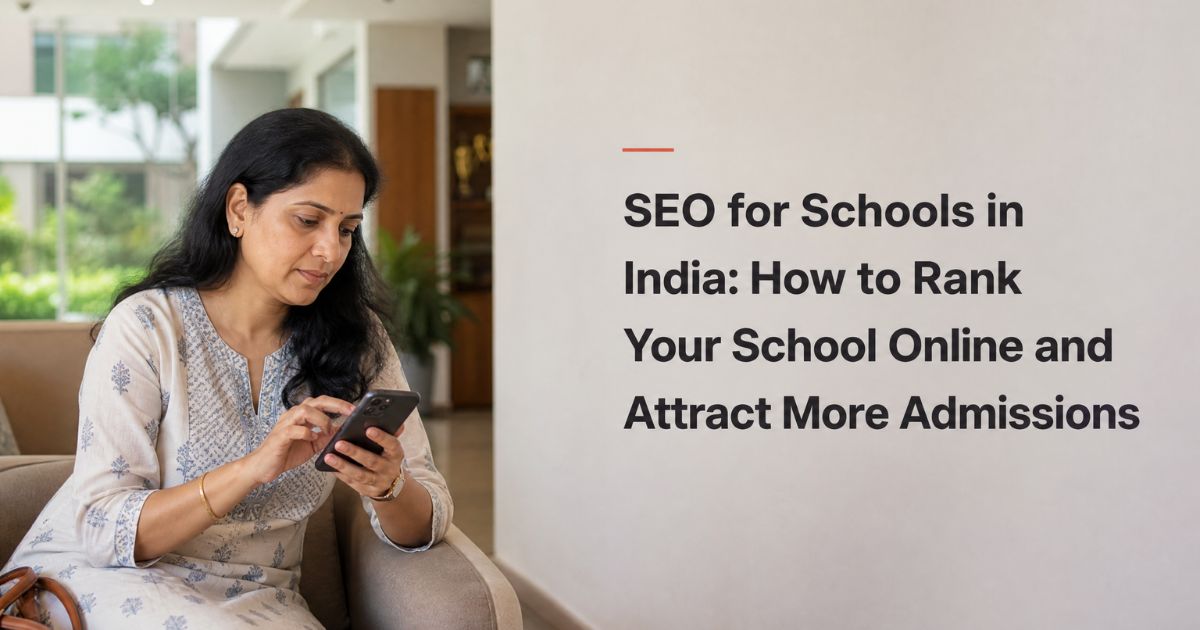
When a parent in India starts looking for a school, the first move is almost never a phone call to your admissions office. It’s a search. “Best CBSE schools in Noida,” “ICSE school near me,” “nursery admission Kanpur 2027” — the shortlist takes shape on a phone screen, often late at night, weeks before anyone books a campus visit. If your school doesn’t appear during that research, you’re quietly out of the running, however good the education inside your gates.
That is the gap SEO for schools in India is meant to close. Handled well, it isn’t about chasing rankings for their own sake. It’s about being present and convincing at the exact moments a parent is deciding where their child will spend the next ten years — and making it easy for them to take the next step. This guide is written for principals, trustees, directors and admission teams who want their website and local presence to bring in genuine enquiries, not just look nice.
How parents actually search for a school
Before you touch a single keyword, it helps to picture the journey a real parent moves through. It usually runs in four stages.
Orientation. Broad questions — “CBSE vs ICSE which is better,” “best board for my child,” “how to choose a school.” The parent is learning, not yet shortlisting.
Shortlisting. Now it gets local and specific — “best CBSE schools in [city],” “ICSE school in [locality],” “schools near me.” This is where visibility starts converting into consideration.
Verification. The parent digs into your specifics — fees, admission process, results, facilities, transport, safety — and cross-checks you against Google reviews and listing platforms.
Action. “School admission in [city] 2027,” a filled enquiry form, a WhatsApp message, or a campus visit. The decision to reach out is made here, on the strength of everything above.
Notice how little of this is about your brand name. Parents who already know you will search for you directly; the growth comes from the parents who don’t yet, and who describe what they want by board, stage, location and need. Your job is to be findable and credible at each stage.
The “best schools in [city]” reality most guides skip
Here’s something generic school-SEO advice rarely tells you honestly. For the biggest head terms — “best schools in Noida,” “top CBSE schools in [city]” — the first page is usually dominated by listing and comparison platforms such as Edustoke, Uniapply and Ezyschooling, which aggregate fees, reviews and rankings and let parents apply in one place. Expecting your own website to outrank all of them for those exact phrases is, in most cities, unrealistic.
So the smart strategy runs on two tracks at once. First, make sure your school is properly listed, accurate and well-reviewed on the platforms parents actually browse — because that’s where a chunk of the shortlisting happens whether you like it or not. Second, win the searches you genuinely can: the more specific, lower-competition terms where an individual school site competes well. “CBSE school in [specific locality],” “[board] school near [landmark],” “admission open 2027 [city],” “school with [specific facility] in [area],” and of course your own brand terms. These convert better anyway, because the parent typing them already knows roughly what they want.
Keyword research for schools, without the guesswork
You don’t need a giant keyword list. You need to map the handful of patterns parents use to the pages that answer them. Think in these buckets and fill them with your board, stages and localities:
- Board + city / locality — “best CBSE schools in [city],” “ICSE school in [locality].” The core shortlisting terms.
- Stage + admission — “nursery admission in [city],” “class 11 admission [board] [city],” “pre-primary admission near me.”
- Year / season — “school admission [city] 2027,” “admission open 2027-28.” These spike sharply during the admission cycle.
- Practical / verification — “[school type] fees in [city],” “documents required for school admission,” “school bus routes [area].”
- Comparison / advice — “CBSE vs ICSE,” “how to choose a school in [city],” “day school vs boarding.”
Match each pattern to a real page or article. If a term has no page that genuinely answers it, that’s a gap to fill — not with thin filler, but with a page a parent would actually find useful.
What parents need from your website (and how to structure it)
A school website earns enquiries when it answers, quickly and clearly, the questions a parent is already carrying. Before rankings, get the substance right. Every serious parent is trying to establish:
- Board and affiliation — CBSE, ICSE, state board, IB or IGCSE, with your affiliation/board code visible.
- Classes and stages offered — from pre-primary through the senior classes you actually run.
- Admission process and, crucially, key dates and deadlines for the current cycle.
- Academic approach, results and what makes your teaching genuinely different.
- Facilities, faculty, safety and transport — the practical reassurances parents scan for.
- Fees, or at least a clear fee-enquiry path; location and directions; and obvious contact options.
Translate that into a clean structure: a strong homepage; an about/affiliation page; academics organised by board and stage; a dedicated admissions page (process, eligibility, dates, enquiry form); a facilities and campus section with real photos; a faculty page; a fees or fee-enquiry page; a contact page with map and directions; and a blog or news section for updates and helpful content. Each of these is a page search engines can rank and a parent can land on directly.
One firm warning: do not spin up a hundred near-identical “school in [locality]” pages to try to blanket a city. That’s doorway-page behaviour, it adds nothing for parents, and Google’s guidelines specifically discourage it. Create a location or branch page only where there is genuinely distinct, useful information — a separate campus, a real second branch. If you need help getting the underlying site right, that often overlaps with website development.
Local SEO and Google Business Profile for schools
Local search is where schools have a real advantage, because unlike many businesses a school unambiguously qualifies for a Google Business Profile — you have a physical campus and you meet parents and students in person. A well-run profile is often the single highest-return local investment you can make, especially for “schools near me” and the map results parents see first on mobile.

Get the fundamentals genuinely right: accurate name, address and phone number, the correct primary category (for example, a CBSE, ICSE or private school category), your real hours, and plenty of authentic campus photos. Keep that name, address and phone number consistent everywhere it appears — your website, Google, JustDial and the education listing platforms — because inconsistent details quietly undermine trust and local ranking. Use Google Business Profile posts to announce admission openings and events during the season.
Legitimate local strength also comes from real local mentions — coverage of a school event in a local paper, participation in inter-school competitions, association or board listings. What it must never come from: fake reviews, invented addresses, or stuffing keywords into your Google business name. Those violate Google’s policies and can get a profile suspended. For a fuller playbook, see Media Sathi’s guide to building a local SEO strategy.
Reviews and reputation — handle them honestly
Parents lean on reviews more for schools than for almost anything else, because the stakes are personal and the decision is hard to reverse. A steady stream of genuine, recent Google reviews does more for your credibility than any slogan on the homepage.
Earn them the right way: ask satisfied parents at natural moments — after a warm parent-teacher meeting, an event, a smooth admission — and make it effortless with a direct review link. Respond to reviews, including the critical ones, calmly and constructively; prospective parents read your replies as closely as the reviews themselves. Never buy reviews, never post fake ones, and never incentivise them. Beyond being against Google’s policies, parents can usually smell a manufactured five-star wall, and it costs you the very trust you were trying to build.
Technical SEO, mobile and speed
Most parents will first meet your website on a phone, frequently on mobile data, often in the evening. If it loads slowly, breaks on a small screen, or buries the admission button, you lose them before the content ever gets a chance.
Cover the basics: a fast, mobile-first design; secure HTTPS; a clean, crawlable structure with a sensible menu; correct indexing of the pages you care about; and an XML sitemap. School sites built on heavy templates often carry avoidable problems — huge uncompressed campus images, content trapped in sliders or PDFs, and broken links after a redesign. Fixing these frequently lifts rankings on its own. The deeper checklist lives in Media Sathi’s technical SEO guide.
Content that helps parents (and quietly earns rankings)
This is where a school can out-perform bigger, better-funded competitors, because so few publish anything genuinely useful. Write the things parents actually ask your front office: “CBSE vs ICSE — which board suits which child,” “documents required for nursery admission in [city],” “what to look for when choosing a school,” a clear explainer of your admission process, or honest pieces on campus safety and transport. Content like this builds trust, answers real questions, and captures the advice-stage searches your competitors ignore. A steady, parent-first content marketing habit compounds over time. Google’s own guidance rewards content that demonstrates real experience and is written to help people first — which, for a school, simply means writing from what you genuinely know about educating children.
Structured data, images and the finer signals
A few smaller pieces round out the picture. Structured data — marking up your school with Organization, LocalBusiness or School schema — helps search engines understand you as a specific entity: your name, location, contact details and type. Treat it as adding clarity, not as a ranking trick; there is no special “school rich result” that vaults you to the top, but clean markup helps you be understood correctly.
For images, use real photos of your campus, students (with due consent and privacy care) and events rather than generic stock, compress them so they load fast, and write descriptive alt text — “primary students in the science lab at [School Name], [city]” rather than “IMG_2043.” Authentic imagery reassures parents and, done properly, supports your visibility in image search too. Sensible internal linking — admissions linking to fees, academics linking to the relevant board page — helps both parents and search engines move through the site.
Building authority and trust
Choosing a school is a high-stakes decision, so credibility signals matter more here than in most sectors. Make your genuine strengths easy to verify: display your board affiliation and code, real faculty profiles, results and achievements, accreditations, and the school’s history and leadership. Earn mentions through real activity — events, competitions, community work, local media coverage — rather than chasing low-quality paid links, which do more harm than good. Trust, demonstrated honestly, is both what parents are looking for and what search engines increasingly reward.
Turning visitors into admission enquiries
Traffic that doesn’t convert is just a number on a dashboard. The point is enquiries. Make the next step obvious and easy: a short, visible enquiry form; a WhatsApp option, which many Indian parents strongly prefer; a downloadable prospectus; and a simple way to book a campus visit. Keep admission dates and “admissions open” messaging prominent during the season. Place your trust signals — results, accreditations, a warm campus photo — right where the parent decides to reach out. And keep forms short: name, parent contact, child’s class and locality are usually enough to start a real conversation. A fifteen-field form loses tired parents at 10pm.

Measuring what actually matters
Judge your SEO by outcomes tied to admissions, not vanity metrics. The numbers worth watching: enquiry-form submissions and calls from organic search; calls and direction requests from your Google Business Profile; your rankings for the priority board-plus-locality and admission terms you chose; and impressions and clicks in Google Search Console for those queries. Read it with the calendar in mind — school search is seasonal, peaking through the admission cycle — so compare like with like, review quarterly rather than daily, and expect organic progress to build over months.
Common school SEO mistakes to avoid
- Treating the website as a digital brochure that’s updated once a year, with last year’s admission dates still on it.
- Chasing only the hyper-competitive “best schools in [city]” head term while ignoring winnable, specific searches.
- Publishing thin, near-identical locality pages to game local search — doorway behaviour that helps no one.
- Neglecting the Google Business Profile, or trying to game it with fake reviews or a keyword-stuffed name.
- A slow, non-mobile-friendly site that buries the admission enquiry button.
- Hiding every practical detail — fees, process, dates — so parents give up and move to a clearer competitor.
- Expecting results in a few weeks. Meaningful organic movement takes months, and no honest partner will promise instant page-one rankings.
A practical 90-day roadmap
A realistic starting sequence for a school new to SEO. It won’t finish the work — SEO is ongoing — but it builds the right foundation, and it’s most powerful when timed to run into your admission season rather than after it.
Days 1–30 — Foundation
Audit the current site and Google Business Profile. Fix the profile first: accurate details, correct category, real photos, consistent name-address-phone everywhere. Do focused keyword mapping around your board, stages and localities, and pick your priority winnable terms. Rewrite the core pages — homepage, admissions, academics — so they clearly answer what parents need, and make sure current admission dates and a working enquiry form are live. Handle the worst technical issues: speed, mobile, indexing.
Days 31–60 — Structure and content
Build out academics by board and stage, a proper fees or fee-enquiry page, and a facilities section with genuine photos. Publish three or four parent-first pieces — a board comparison, an admission-documents guide, a how-to-choose article. Add Organization/School structured data. Start earning genuine Google reviews from happy parents, and get listed accurately on the education platforms and local directories parents use.
Days 61–90 — Conversion, authority and iteration
Sharpen conversion: WhatsApp enquiry, prospectus download, campus-visit booking, trust signals near every call to action. Pursue two or three real local mentions — event coverage, an association listing. Review Search Console for the terms you’re beginning to rank for and strengthen those pages. Set up tracking so every enquiry’s source is known, then plan the next quarter around the admission calendar.
When to bring in help
Plenty of this can start in-house, especially the parts only your team can write — your real academic approach, your genuine differentiators. Outside help tends to make sense when the technical fixes need development work, when the site needs restructuring, when you’re competing in a crowded metro market, or simply when the admission team has no time to run this consistently through a season. The honest test is capacity and expertise, not the size of the school.
Conclusion
Parents now form their school shortlist online, long before they call or visit. That makes SEO for schools in India less of a marketing luxury and more of a basic requirement for staying in consideration. The schools that do it well aren’t the ones with the flashiest websites — they’re the ones that clearly answer what parents need, run an honest and active Google presence, earn genuine reviews, and make enquiring easy. None of it guarantees rankings or admissions, and anyone promising that should be treated with caution. What it does build is a durable, trusted presence that keeps working for you, season after season.
A note from Media Sathi
Every school draws from a different catchment, competes in a different market and runs a different admission cycle, so a useful SEO plan starts from your specifics rather than a template. If you’d like a strategy shaped around your board, your city and your admission goals, Media Sathi works with education-sector clients and can help you put one together — you can see our approach on the Education page, or book a free growth audit to talk it through. No commitment required.
FAQs :
Q1. How long does SEO take for a school to see admission enquiries?
Usually a few months of consistent work before steady enquiries build, and longer in competitive metro markets. Because school search is seasonal, the smart move is to have the groundwork in place ahead of your admission cycle rather than starting mid-season. It’s a compounding channel, not an instant one.
Q2. Can our school realistically rank #1 for “best schools in [city]”?
For those broad head terms, the first page is usually held by listing and comparison platforms, so ranking #1 there is unrealistic for most individual schools. A better goal is to be well-listed and well-reviewed on those platforms while your own site wins the more specific, winnable searches — board plus locality, admission-year terms, and your brand.
Q3. Do schools really need a Google Business Profile?
Yes. Schools clearly qualify because you have a campus and meet parents in person, and the profile is often the highest-return local investment you can make — especially for “schools near me” and map results on mobile. Keep it accurate and earn genuine reviews.
Q4. Should we create a separate page for every locality we draw students from?
No. Publishing many near-identical locality pages is doorway behaviour that helps no parent and works against you. Create a location or branch page only where there’s genuinely distinct, useful information, such as a separate campus.
Q5. How do we get more Google reviews without faking them?
Ask real, satisfied parents at natural moments — after events, meetings or a smooth admission — and make it easy with a direct review link. Respond to reviews thoughtfully. Never buy, fake or incentivise them; parents notice, and it breaks the trust you’re trying to build.
Q6. Should we show fees on the website?
Parents actively search for fees, so hiding every detail frustrates them and sends them to clearer competitors. Whether you publish a full fee structure or a clear fee-enquiry path is your call, but some transparency reduces friction and builds trust.
Q7. Is SEO better than running admission ads?
They work best together. Paid ads are useful for sharp visibility during the admission-season spike; SEO builds durable, year-round visibility and lowers your long-term cost per enquiry. Most schools benefit from combining the two rather than choosing one.


