
Most B2B companies that try video end up with one expensive corporate film, a YouTube channel with eleven subscribers, and a quiet suspicion that the money went nowhere. Usually the film was fine. The problem was that nobody decided, before the shoot, what it was supposed to make happen.
Video marketing for lead generation is a different exercise from video production. It starts with a question a buyer is already asking, puts the answer where that buyer is already looking, and ends with an easy way for them to raise their hand. The camera work is the easy part.
This guide is for B2B teams who need enquiries rather than impressions : SaaS and IT companies, manufacturers and engineering firms, professional services practices, and the marketing managers inside them who have to justify the spend. It covers which videos actually earn leads, how to get them found on YouTube and LinkedIn, where the capture form belongs, how to qualify and nurture what arrives, and how to tell whether any of it reached pipeline. Where something depends on how a platform behaves, it links to that platform’s own documentation rather than to somebody’s blog post about it.
What B2B video marketing actually means
B2B video marketing is the use of video to move a business buyer through a decision that several people will make together, over weeks or months. That sentence is doing more work than it looks.
Several people means no single video serves your whole audience. A CTO evaluating an integration, a procurement manager comparing quotes and a plant head worried about downtime need different proof, and they rarely watch the same thing. A video built to satisfy all three usually satisfies none.
Over weeks or months means a video’s job is almost always to advance a decision, not to close it. A testimonial does not produce a purchase order. It removes one of the four reasons somebody was hesitating, which is a smaller and much more achievable claim.
Several people will make together matters most. The decision happens inside the buyer’s organisation, largely without you in the room. Video travels into that room unusually well, because it can be forwarded, and because a two-minute clip gets watched by a busy promoter when a twelve-page proposal does not.
What B2B video marketing is not is B2C video marketing with longer run times. Reach is not the goal and can actively mislead. A video with 400 views, every one of them from the eleven accounts on your target list, is worth more than one with 40,000 views from an audience that will never buy. If your reporting cannot tell those two apart, that is the first thing to fix.
Where video sits next to the rest of your marketing
Video almost never generates leads on its own. It works as the middle piece of a three-part chain: search or social brings a buyer who has a problem, video convinces them you understand it, and the page around the video captures them. Weaken any link and the other two stop mattering.
This is why video planning should follow your keyword and account research rather than precede it. If you already know which queries bring in qualified traffic, you already know which videos to make. Our B2B SEO guide for generating leads in India covers that side of the chain; this guide assumes you have some idea of what your buyers search for, even if the list is rough.
Why video marketing for lead generation works differently in B2B
The usual argument for video in B2B is that people prefer watching to reading. That is probably true and it is not very useful, because it does not tell you what to make. Three structural facts about B2B buying are more useful.
You are persuading a committee, in sequence
In most B2B purchases one person finds you, a second evaluates you and a third approves the spend. They encounter you at different times, through different channels, with different anxieties. The practical consequence is that your video library should be a set of answers to specific objections, mapped to the people who raise them, rather than a set of films about your company.
This reframes the production question. Instead of asking what video to make next, ask : which person, at which stage, is stalling, and what would they need to see?
Video compresses explanation, and unexplained value is what stalls deals
B2B offerings are frequently hard to describe. A pharmaceutical-grade coating process, a logistics integration, a compliance service : the value is real and takes four paragraphs to convey in writing. Shown on screen, with the thing actually working, it takes forty seconds.
That compression is the strongest commercial argument for video in B2B. It shortens the period in which a buyer does not yet understand what you do, and that period is where most enquiries quietly die.
The video rarely converts anyone; the page around it does
The single most common structural mistake in B2B video is treating the video as the conversion event. It almost never is. A buyer watches, becomes interested, and then needs something to do within arm’s reach : a form, a calendar link, a WhatsApp button, a downloadable spec sheet.
So the quality bar for a lead-generating video is not just whether it was watched. It is whether the page or post around it made the next step obvious in the two or three seconds before attention moved on. Treat the player and the capture mechanism as one asset, designed together, and a surprising number of video programmes start working without any change to the videos themselves.
Map video to the buying journey before you book a shoot
Every guide on this topic tells you to map video to the funnel. Fewer say what each stage actually needs, and almost none include the stage where B2B deals most often stall. Here is a five-stage version that matches how these purchases tend to resolve in practice.
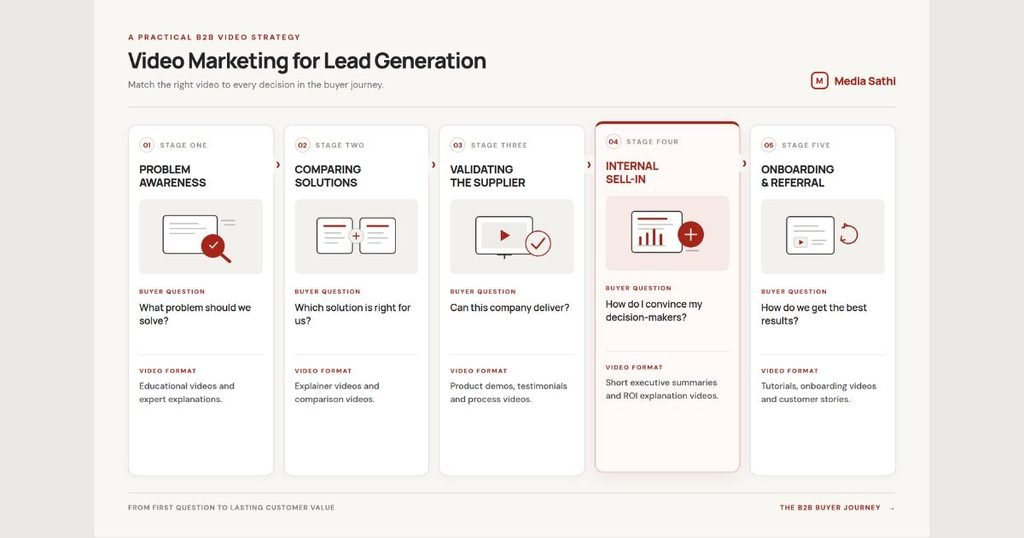
Stage 1 : the buyer is problem-aware
They are asking whether the problem is worth solving and who seems to understand it. They are not yet shopping.
What works here is a short video that answers a question they would type into a search box, a recorded expert session, or a founder taking a clear position on something contested in the industry. What does not work is a brand film. Nobody searching for why a coating fails after the monsoon wants your company’s history.
The honest lead goal at this stage is zero. You are buying attention and a return visit. Judge it on new viewers and on whether any of them come back for a second video.
Stage 2 : the buyer is comparing approaches
Now they are asking what their options are and how those options differ. This is where explainers earn their keep, along with how-it-works animations and genuine comparison videos that admit where your approach is the wrong choice.
That admission is not a risk. A video that says “if you only need this twice a year, outsource it instead” buys more credibility than any claim of being the market leader, and it filters out enquiries your sales team would have wasted a fortnight on.
The realistic conversion here is soft : a spec sheet download, a calculator, a newsletter sign-up.
Stage 3 : the buyer is validating you
The question becomes whether you can actually do this, for a company like theirs. Demos, testimonials, process films and walkthroughs with real data belong here, and this is where video genuinely produces enquiries. Demo requests, quote requests and site-visit requests all come from this stage.
Stage 4 : your champion has to sell the decision internally
This is the stage most frameworks skip. Someone inside the buying company now has to explain your proposal to a managing director, a finance head or a committee, in a meeting you will not attend.
The asset that helps is a 90-second video they can forward : the problem in one line, your approach, what measurably changes, and what it costs to do nothing. Plain delivery, no music bed, nothing that looks like an advertisement, because it has to survive being watched by a sceptical promoter who did not ask for it.
Illustrative example, not a client result. A capital-equipment supplier keeps losing deals at the approval stage. Sales records a 90-second video per deal : the buyer’s own numbers, the downtime being eliminated, the payback period, and one line on what delay costs. The champion forwards it instead of re-explaining the proposal second-hand. The outcome to watch here is cycle time and win rate at the approval step, not lead volume.
Very few B2B companies make this video. It is usually the highest-leverage asset in the entire library.
Stage 5 : onboarding, retention and referral
Onboarding walkthroughs and a how-to library reduce support load and, more usefully, create the conditions for a customer story worth filming later. Customers who were onboarded well agree to be filmed. Customers who struggled do not.
The video types that generate B2B leads, and the brief for each
Below is each format with the detail a brief actually needs : what it is for, how long it should run, how to structure it, and what the call to action should be.
Explainer videos
Job : make an unfamiliar offering legible fast. Length : 60 to 90 seconds for a single product, up to two and a half minutes for a service with several steps. Structure : the buyer’s problem in one sentence, why the usual approaches fall short, what you do shown rather than described, who it is for, one call to action. CTA : something specific to their situation, such as seeing how this would work on their line or in their stack, pointing at a page with a short form.
The most common failure is opening with the company. Open with the buyer’s situation; you have about eight seconds before they decide this is an advertisement.
Product demos and walkthroughs
Job : prove the thing works and is not painful to adopt. Length : three to six minutes for a core workflow. A library of 60 to 90-second clips, one per job to be done, almost always converts better than a single long demo. Structure : one task per video. Start inside the product rather than on the login screen. Narrate the decisions, not the clicks. CTA : book a demo, start a trial, or request a configuration walkthrough.
Gate the long demo if you gate anything. Leave the short clips open, because their job is to be found and forwarded.
Customer testimonial and case-study videos
Job : let a peer answer the risk question on your behalf. Length : 90 seconds to two and a half minutes, plus three or four 20-second quote clips cut for social and sales email. Structure : the situation before, what they tried, why they chose you in their own words, what changed with their own numbers, and who else should consider this.
The most valuable question in a testimonial interview is what they were worried about before signing. The answer is usually the fifteen seconds that moves the next prospect. Do not script the customer, and get written permission before publishing any figure they quote.
Thought leadership and founder-led video
Job : become the person a buyer trusts on this problem before they are ready to buy. Length : two to five minutes, published weekly or fortnightly. Consistency beats production value here by a wide margin. Structure : one opinion per video, stated early and defended.
For Indian B2B audiences, founder-led video in Hindi or Hinglish frequently outperforms polished English, particularly with buyers in tier-two and tier-three markets. Subtitle it in English and you lose nothing on either side.
Capability, plant and process films
Job : stand in for the site visit a buyer is not yet willing to travel for. Length : two to three minutes, with a 45-second cut for WhatsApp and dealer sharing. Structure : scale, process, quality control, certifications and compliance, despatch.
Industrial buyers, distributors and overseas importers shortlist on perceived capability, and a working line on camera does what a brochure cannot. If you also want those buyers arriving through search, our guide to SEO for manufacturers in India covers the enquiry side of the same problem.
Sales videos, one-to-one and one-to-many
One-to-one means a 45 to 90-second personal video in outreach or in a follow-up email, with the prospect’s company named on screen. One-to-many means recorded answers to the eight questions your sales team answers every week, so the reply becomes a link instead of a re-explanation.
This is the cheapest category on the list, needs no crew, and in most B2B companies returns more per rupee than anything else here.
Webinars and the cuts you make from them
A webinar is two things at once : a lead-capture event where attendance requires a name, and a content factory. One 45-minute session yields the gated full recording, a six to eight-minute highlight reel, five to eight short clips, a blog post from the transcript, and a short FAQ video built from the questions the audience actually asked.
It is the format most likely to produce a named, qualified lead in a single step, which is why it is usually worth running even when your list is small.
Where to start, by industry
Most teams can shoot the raw material for all three themselves; a phone on a tripod with a clip microphone is enough for everything except the plant film. The bottleneck is almost always what happens afterwards, which is where our video editing and post-production services fit : the edit, colour, sound cleanup, motion graphics, subtitles in English, Hindi or Hinglish, and the platform cuts in 16:9, 1:1 and 9:16 so one shoot becomes a month of distribution. If the scripts are the bottleneck instead, that sits with content marketing and video scripting.
YouTube SEO for B2B : getting found by people already searching
In technical categories, a buyer’s instinct after a vague search is to watch somebody do the thing. That makes YouTube one of the few channels where B2B demand is genuinely pull rather than push, and it is the part of video marketing most B2B teams leave on the table because their channel is organised around their company rather than around questions.
Choose queries a buyer types, not topics a brand likes
Start in YouTube’s own search box. Type the problem your product solves and read the suggestions; they reflect what people on that platform actually look for, which is not always what they search on Google. Then group the suggestions into clusters by service line and buying stage.
For an ERP implementation firm, one cluster might run : why ERP implementations fail at the problem-aware stage, ERP vs custom software for manufacturing while comparing, SAP B1 implementation timeline while validating, and how to train staff on a new ERP after purchase. Four videos, one cluster, each answering a question in the buyer’s own words.
Resist the urge to make videos about your product’s features. Feature videos belong on your site, where the audience has already arrived. YouTube rewards answers.
Titles, descriptions and chapters
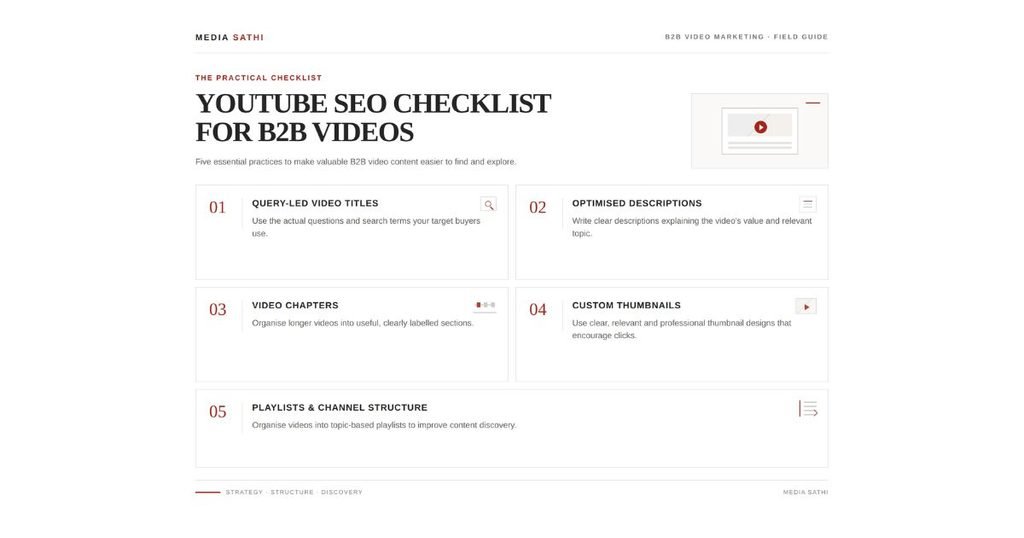
Titles should lead with the query, not with your brand. Keep them short enough that they survive truncation in suggested feeds, which in practice means staying under roughly sixty characters. Avoid capitals and exclamation marks; a B2B buyer reads them as noise.
Descriptions earn their value in the first two lines, because that is all that shows before the viewer has to click for more. Put the query and the payoff there. Below that, write a real summary of what the video covers and include exactly one link, pointing at the page where the enquiry can happen. A description crammed with ten links dilutes the only click that matters.
Chapters are the most underused feature in B2B. You create them by listing timestamps in the description, and YouTube’s requirements are specific : the first timestamp must be 00:00, there must be at least three listed in ascending order, and each chapter has to run at least ten seconds (YouTube Help). For B2B the benefit is not only search; it is that a prospect who forwards your demo to a colleague has given that colleague a way to watch only the ninety seconds that concerns them.
Thumbnails and the first thirty seconds
Ranking well is worthless if nobody clicks. Design thumbnails to be legible at phone size : three or four words, high contrast, and either a real face or the actual object. Stock imagery and your logo on a gradient both perform badly.
Then earn the first thirty seconds. Say the question you are answering, almost verbatim from the title, in the opening line. Business viewers are checking whether they are in the right place, and a thirty-second branded intro answers that question badly.
Playlists, end screens and channel structure
Playlists are the cheapest structural win available and are missing from nearly every B2B channel. Build one per service line and, where you have the material, one per buying stage. Sessions matter to the platform, and a playlist is the simplest way to turn one video into three.
Set a 60 to 90-second channel trailer that answers who the channel is for and what they will get. Use end screens to point at the next logical video rather than a generic subscribe prompt, and organise the channel’s sections so a visiting procurement manager can find the demo without scrolling past your Diwali post.
YouTube SEO is not the same as video SEO on your own site
These are two different jobs and conflating them is why so many B2B sites have video nobody finds.
Google’s video SEO best practices set out what makes your own pages eligible for video results. The points that matter most in practice : give a video a dedicated watch page whose main purpose is showing that one video, because a blog post or category page where the video is secondary is not treated as a watch page; give each watch page a title and description specific to that video; and make sure the video has a valid thumbnail at a stable URL that Google can fetch.
On top of that, mark the page up with VideoObject structured data, where name, thumbnailUrl and uploadDate are the required properties, and use Clip if you want to specify your own key moments rather than letting Google detect them. If you publish video regularly, add a video sitemap, which requires <video:video>, <video:thumbnail_loc>, <video:title>, <video:description> and at least one of <video:content_loc> or <video:player_loc>.
The practical takeaway: embedding a YouTube video in a blog post does not make that post a video page in Google’s eyes. If you want the page itself to show up in video results, give the video a page of its own. This is ordinary technical SEO work rather than video work, and it sits alongside the rest of your on-site foundations, covered in our technical SEO guide and handled as part of SEO services.
LinkedIn video marketing that starts conversations
LinkedIn is where B2B video gets seen by people with job titles you care about. It is also where most B2B video goes to die, because it is posted the way a press release is posted.
What to post organically
Upload natively rather than linking out; a video hosted on the platform behaves better in the feed and stays reusable as an ad later. Write the first frame as a readable text statement, because the feed autoplays silently and a muted opening shot of your office does nothing. Burn in or add captions as a default, not as an accessibility afterthought.
Keep organic posts to 30 to 90 seconds, square or vertical, and put one idea in each. Then do the part nobody wants to do: answer every comment in the first hour, from a person’s account rather than the company page. In B2B, the comment thread is usually where the actual conversation that becomes a lead starts. If this is the piece you do not have capacity for, it is the core of what social media marketing and LinkedIn management covers.
When to put money behind it
Promote what has already earned attention organically, rather than guessing. LinkedIn video ads run in the feed and across the LinkedIn Audience Network, and you can either sponsor an existing Page post or build a new video ad in Campaign Manager (LinkedIn Help).
The sequence that works : a short problem-framing video to a tightly defined audience, then retarget the people who watched a meaningful share of it with the demo or the testimonial. Retargeting a video audience is far cheaper than prospecting cold, and it is the one place where paid video reliably produces enquiries rather than impressions.
Lead forms or landing pages
LinkedIn’s Lead Gen Forms pre-fill from a member’s profile data and can be attached to several formats including video ads, with up to twelve informational fields available (LinkedIn Help). They remove almost all friction, which cuts both ways.
The trade-off, stated plainly : forms convert at a far higher rate but produce leads who never visited your site, often with lower intent, so they need faster and warmer follow-up. Landing pages convert worse but produce better-qualified leads and let you retarget the visit. A workable rule is to use a form for a top-of-funnel asset such as a guide or webinar registration, and send people to a page when you are asking for a demo or a quote.
Whichever you choose, ask for the minimum that lets sales route the lead. Name, work email, company and one qualifying question will beat eleven fields every time.
Distribution : one video working in six places
A video that lives only on YouTube is doing a fraction of its job. Each asset should be placed deliberately in six places:
Your own site. A dedicated watch page, plus an embed on the service page the video supports.
Email. Most email clients will not play an embedded video, so use a still frame with a play icon that links to the page. Subject lines that name the question beat subject lines that announce a video.
WhatsApp. In Indian B2B this is where dealers, distributors and field sales actually share things. Keep a cut under sixty seconds, sized and compressed to forward cleanly, with the enquiry number on the closing frame.
Sales outreach. The one-to-many library, plus one-to-one recordings for named accounts.
Events and trade shows. Film there and screen there. A booth reel and a set of on-floor customer interviews pay for the travel twice.
Paid retargeting. Audiences built from video viewers and page visitors, run across LinkedIn, YouTube and Meta as the audience warrants. That campaign work sits with performance marketing.
Repurposing is what makes this affordable. One properly planned two-hour shoot should produce a long-form video, three to five short vertical cuts, a set of quote graphics, an audio track for a podcast feed, and the transcript for a blog post. If the shoot is planned around that output list, the cuts cost almost nothing. If it is not, you will be paying an editor to invent them later.
Lead capture : where the form goes, and whether to gate
This is the part of video marketing for lead generation that most guides skip, and it is where the leads are either collected or lost.
The gating decision, as arithmetic
Gating gets argued about as though it were a matter of principle. It is a calculation, and it is one most companies have never run.
For any asset, estimate two things using your own numbers. First, the enquiries you would expect if the video were open and discoverable : views, multiplied by the share who click through to the page, multiplied by the form completion rate. Second, the enquiries you would expect if it were gated : impressions, multiplied by form completion. Then discount the gated figure by the proportion your sales team will disqualify, which for a gated asset is usually substantial. If gating still wins after that discount, gate it. If it does not, do not.
Three rules of thumb that hold up across most B2B companies :
Never gate explainers, short demo clips, testimonials, or anything meant to be forwarded inside the buyer’s company. Gating the stage-four summary video defeats its only purpose.
Usually gate webinar recordings, long-form demos, and benchmark or technical reports with a video walkthrough attached.
Never gate twice. If somebody registered for the webinar, the follow-up clips are open to them without another form.
Three capture patterns that work
The watch page with an inline form. The video sits at the top, the form sits directly beneath it, and on mobile both are visible without scrolling. This is the default for anything you want indexed, and it is also the pattern that benefits from the video SEO work described earlier.
Progressive capture. The video plays openly, and a short form appears at the point of commitment, usually somewhere past the halfway mark, with the video still visible behind it. This preserves discoverability while still producing a record, and it suits long demos well.
Open video with one strong next step. No form at all : a calendar link, a WhatsApp click-to-chat button, or a quote request on the service page. For high-consideration purchases this often outperforms a form, because the buyer who is ready wants a conversation, not a download.
Whatever you choose, test it on a phone over a patchy connection. A form that needs pinch-zoom, or a page that takes six seconds to show the player, will lose enquiries that the video had already earned. Page speed and form behaviour are part of the video programme, which is why they sit inside website development rather than being treated as somebody else’s problem.
Qualifying and nurturing with what the video tells you
Video produces a kind of signal that a PDF download never will. You know which video they watched, how far they got, which chapter they replayed, and whether they came back.
Used properly, that turns into qualification :
Somebody who watched the pricing or implementation section through to the end is a materially stronger lead than somebody who watched the first twenty seconds of three videos.
Three views from the same company domain inside a week usually means an account is evaluating, not that one person is curious. Treat it as an account signal and tell sales.
Repeat views of the same demo often mean the link is being shared internally. That is stage four happening without you. It is the moment to send the forwardable summary video, unprompted.
A nurture sequence does not need to be elaborate. Illustrative example, not a client result : three emails over ten days, where the first sends the next logical video in the cluster, the second sends a testimonial from their industry, and the third makes one specific offer such as a sample edit, a site visit or a technical call. In India, a 45-second WhatsApp follow-up, sent with consent, frequently gets opened where the same message in email does not.
One honest caveat. None of this works unless somebody looks at the data weekly and acts on it. A scoring model nobody reads is worse than no model, because it creates the impression of a process.
Measuring video marketing for lead generation
Four layers of metrics
Most B2B video reporting stops at the first two layers. That is the main reason video budgets get cut : the report proves the video was watched and says nothing about whether it earned anything.
Instrumentation : what to actually set up
In this order, because each step depends on the one before it.
Give every video its own page with its own URL. Until this exists, nothing downstream can be attributed.
Mark the enquiry as a key event in your analytics. In Google Analytics 4 these are called key events, and Google’s guidance is to use a recommended event such as generate_lead rather than inventing a custom one where possible.
Capture the source on the form itself. A hidden field holding the page URL, or a short “how did you hear about us” question, resolves arguments that no attribution model will.
Create one CRM field for first-touch asset and make it required at qualification. One field, filled by sales, beats a dashboard nobody trusts.
Build retargeting audiences from viewers and page visitors while you have the volume, not after a campaign ends.
Review monthly against three questions : which videos produced enquiries, which produced the enquiries that became opportunities, and what the answer to those two tells you to make next.
On benchmarks, honestly
You will find confident benchmark figures for video conversion rates in a lot of articles on this subject. Most trace back to a small number of vendor surveys of self-selected customers, across offers and price points that have nothing in common with yours, and are reproduced without a link to the original. We are not going to add to that.
Set your own baseline instead. Run for one quarter, then compare yourself against yourself. Three targets worth holding in the first quarter : at least one video live for every buying stage, a cost per qualified lead below what you currently pay on paid search, and a named source recorded on every single enquiry.
Nine mistakes that waste B2B video budgets
One expensive film instead of twelve useful ones. The brand film is usually the last video you need, not the first.
Opening with the company instead of the buyer’s problem. Nobody watches your founding story before they trust you.
No capture mechanism within reach of the player. The most common and most expensive mistake on this list.
Gating everything, so nothing gets found, shared or forwarded.
Treating the YouTube channel as a dumping ground rather than an answer library organised into playlists.
Posting YouTube links to LinkedIn instead of uploading natively.
Ignoring sound-off viewing. No subtitles, no text-led first frame, no chance.
Reporting views as results. This is how a working programme gets defunded.
Stopping after six weeks. Search-led video compounds slowly; a channel judged at week six will always look like a failure.
There is a tenth, which is less a mistake than a structural problem : nobody owns it. Video spread across a designer, an agency, a sales lead and whoever has the login tends to produce assets and no programme.
A 90-day plan for a small team
This assumes a marketing team of two to four people, no studio, and a phone, a tripod and a clip microphone.
Days 1 to 30 : one question, one video, one page
Pick the single question your sales team answers most often. Script a 90-second answer, record it, have it edited with subtitles, and publish it on a dedicated page with a short form under the player. Set up the key event and the CRM source field in the same month. Upload a native cut to LinkedIn and a 16:9 version to YouTube with a real description and chapters.
The deliverable for month one is not a video. It is a working chain from question to enquiry, which you can then repeat.
Days 31 to 60 : proof and distribution
Record one customer testimonial and one demo or process film. Cut four short verticals from what you now have. Build the first playlist. Start the LinkedIn posting rhythm at one or two videos a week and answer every comment. Put a WhatsApp-sized cut in the hands of sales and dealers. If something has clearly earned organic attention, put a small budget behind it and build a retargeting audience from the viewers.
Days 61 to 90 : compounding
Use the month-two data to choose month-three production rather than guessing. Fill the gaps in the journey table, which for most companies means the stage-four forwardable summary nobody has made yet. Add VideoObject markup and, if you are publishing regularly, a video sitemap. Run the first proper review : which videos produced enquiries, which produced opportunities, and what the next quarter should look like.
By day 90 you should have eight to twelve assets, one measurable chain, and enough data to stop guessing. That is a programme. One film is not.
Getting help with this
Video marketing for lead generation usually fails for one of three reasons : nobody decided what each video was for, nothing captured the interest it created, or nobody measured it long enough to learn anything. All three are fixable, and none of them is a camera problem.
If you would like a second opinion on where your version of this is leaking, Media Sathi offers a free growth audit. We look at the video assets you already have, the pages they point to, how your YouTube channel is structured and whether your tracking would survive a question from your MD, then come back with the three changes most likely to matter. Request a free growth audit, or call +91 91512 22403.
If you already know which piece you need, the production, content, social and paid parts of this all sit under one roof: see our digital marketing services.
FAQs :
Q1 : How does video marketing generate B2B leads?
A : Video rarely generates a lead by itself. It works as the middle of a chain : search or social brings a buyer with a problem, the video convinces them you understand it, and the page around the video captures them. In practice that means pairing each video with one obvious next step, whether that is a form, a calendar link or a WhatsApp enquiry, and making sure the next step is visible without scrolling on a phone.
Q2 : What type of video works best for B2B lead generation?
A : For direct enquiries, demos and customer testimonials convert best because they answer the risk question. For getting found in the first place, short videos that answer a question a buyer would actually search for do the most work. If you are starting from nothing, record a 90-second answer to the question your sales team gets asked most often; it is the cheapest video to make and the easiest to measure.
Q3 : How long should a B2B marketing video be?
A : Match length to the job. Explainers run 60 to 90 seconds. Testimonials run 90 seconds to two and a half minutes. A demo of a full workflow can run three to six minutes, though a library of 60 to 90-second clips, one per task, usually performs better. Social cuts should be 30 to 90 seconds. The forwardable summary a champion sends internally should never exceed 90 seconds.
Q4 : Do I need an expensive production setup to start?
A : No. A phone on a tripod, a clip microphone and decent daylight cover everything except a plant or process film, which benefits from a proper crew. The money is better spent on post-production than on cameras, because the edit, subtitles and platform cuts are what turn one recording into a month of distribution. Consistency outperforms production value, particularly for founder-led video.
Q5 : Should B2B videos go on YouTube or LinkedIn?
A : Both, for different reasons. YouTube captures people searching for an answer, so it suits evergreen explainers, demos and how-to content, and it compounds slowly over months. LinkedIn reaches people by job title whether or not they are searching, so it suits short opinion pieces, customer proof and anything you want in front of a named account this week. Upload natively to LinkedIn rather than posting a YouTube link.
Q6 : How long before video marketing produces leads?
A : Sales videos and LinkedIn can produce replies within weeks. Search-led YouTube content and video pages on your own site compound over a quarter or more, which is why channels judged at week six almost always look like failures. A fair first checkpoint is 90 days, by which point you should have eight to twelve assets and enough data to choose what to make next rather than guessing.
Q7 : How do I measure whether video is generating leads?
A : Set it up in order. Give each video its own page with its own URL, mark the enquiry as a key event in Google Analytics 4, capture the source on the form itself with a hidden field holding the page URL, and add one CRM field for first-touch asset that sales must complete at qualification. Then review monthly : which videos produced enquiries, and which produced the enquiries that became opportunities.


